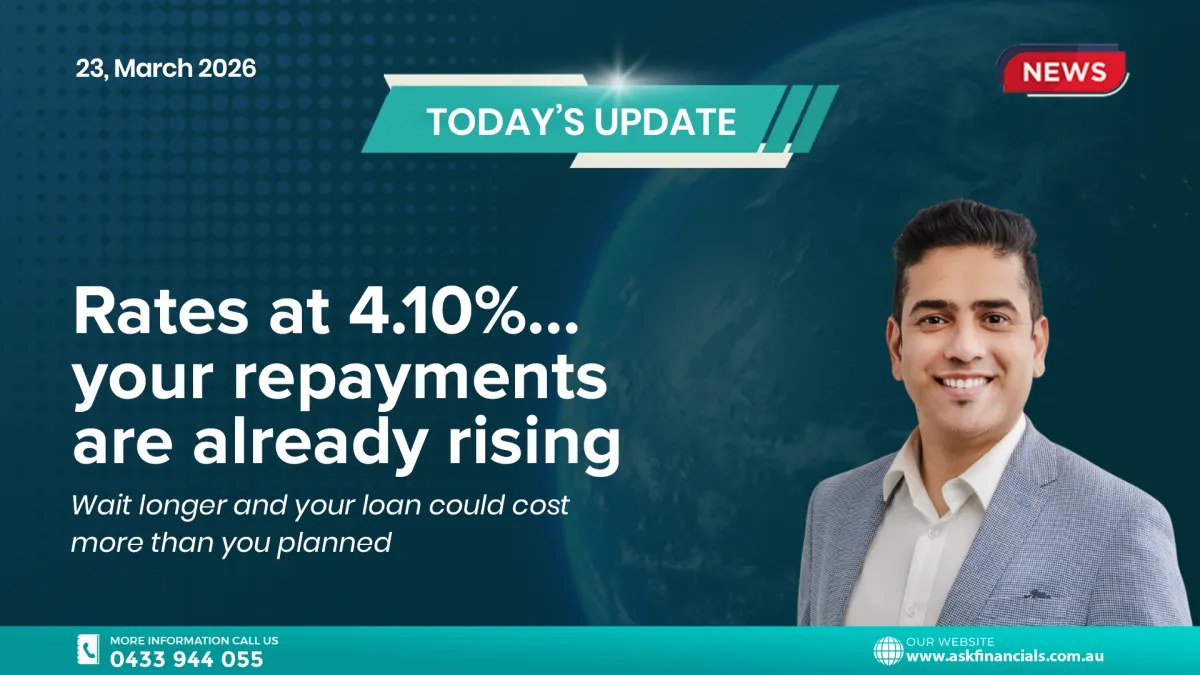
RBA Lifts Cash Rate to 4.10%: What Borrowers Pay Now
RBA Rate Rise March 2026: What It Means for Your Home Loan
The RBA has confirmed a 0.25 percentage point rise at its March 16–17 meeting, lifting the cash rate from 3.85% to 4.10%. The decision was widely anticipated — a Reuters poll just weeks ago found 23 of 30 economists had forecast this move. Looking ahead, major banks including ANZ, CBA, NAB and Westpac are flagging rates near 4.35% by mid‑2026, meaning further tightening may still be on the way.
Key context:
Australia’s economy is firing up. GDP grew 2.6% over the past year, the fastest in nearly three years. Strong growth adds to inflationary pressure.
Inflation is still above the RBA’s 2–3% target band. Inflation forecasts are trending up, not down.
Global risks aren’t helping. Oil and energy prices have spiked on the Middle East conflict, adding a fresh inflation upside risk.
Markets and policymakers see further tightening. Officials have warned that inflation expectations must stay in check, and markets are pricing a series of hikes.
What this means for Home Loan Holders
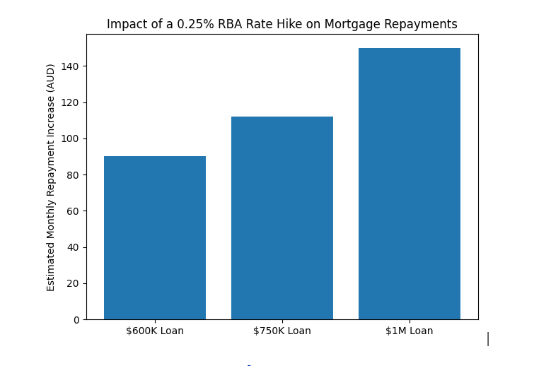
In practical terms, higher cash rates will flow through to higher mortgage rates and repayments. Lenders tend to pass on RBA moves, especially to variable-rate loans. For example, Canstar analysis shows a 0.25% increase in the cash rate would add roughly $90 per month on a $600,000 mortgage, about $112 on a $750,000 loan, and $150 on a $1 million loan. In other words, many borrowers will see their minimum repayments rise noticeably even for a single rate hike.
Higher repayments. Every 0.25% rise boosts monthly payments (see figures above). Over time, a few hikes can add hundreds to thousands extra each month, depending on the loan size.
Tighter borrowing power. Higher rates mean banks charge more interest when testing your loan. Your borrowing capacity will shrink. (Canstar modelling suggests each 0.25% hike can cut a single borrower’s loan size by roughly $12K, and double that after two hikes.) Simply put, the same income won’t buy as big a loan as it did a year ago.
Affordability pressure. With the cost of living already high, any rate rise needs to be budgeted for. Borrowers will need to consider rate buffers. For example, you can use an offset account or pay a bit more than the minimum to cushion future hikes.
We’re here to help you navigate these shifts. Ready to make your move? For tailored advice on your home loan or property plans, contact Ask Financials and book a free consultation today. Call us on 0433 944 055 or email [email protected]. Our brokers will review your situation, explain the options (fixed vs variable, refinancing, buffers, etc.), and help you stay on track. Follow us on Instagram and LinkedIn for more insights and updates.
