

When Should You Refinance Your Home Loan in Australia (2026 Guide)
When Should You Refinance Your Home Loan in Australia (2026 Guide)
Most Australian homeowners don't lose money by making a bad decision. They lose it by not deciding at all. Your lender has no obligation to keep your rate competitive; that's your job. And in 2026, with the RBA cash rate at 4.10% and lenders actively competing for new customers, the lowest advertised rates are starting from around 5.08% p.a., depending on the borrower profile and LVR. This gap between what loyal borrowers pay and what the market offers is wider than most people realise. The real question isn't whether refinancing your home loan is worth thinking about. It's about whether you've actually thought.
The Clearest Signal: Your Rate Is Out of Step With the Market
There's one number that answers most of the 'should I refinance' question: the gap between your current rate and the best home loan rate available for your loan size and LVR. As of April 2026, the average variable rate across Australian lenders sits around 6.45%–6.65%, while competitive offers start well below that. If you haven't had your loan reviewed in the last 12–18 months, your rate may no longer be aligned with the most competitive offers currently available.
A 0.50% rate difference on a $650,000 loan can cost roughly $3,000–$3,300 per year in additional interest, depending on the loan structure. That's money going to your lender, not your offset account, not your savings, not your next property. And the first step is simply to compare your current rate with what a new borrower with your profile would be offered today.
Signs You're Paying Too Much on Your Home Loan
The 'loyalty tax' is a real pattern in Australian lending. It’s commonly observed that lenders often offer more competitive rates to new customers than to existing borrowers. If any of the following sound familiar, you're likely overpaying:
• You haven't received any communication from your lender about rate reviews or product changes in the last year
• Your rate starts with a 6, and you're not sure when you last compared it to the market
• You're on a standard variable rate that your lender reverted you to after a fixed term expired without you renegotiating
• You have significant equity built up, but your loan terms haven't changed to reflect your improved LVR position
None of these means refinancing is automatically the right move. But each one is a reason to check. And checking costs nothing.
How Much Can You Actually Save and How Long to Break Even
The savings question is always specific to your situation, but the framework is simple. Refinancing costs typically run between $500 and $2,000 for discharge fees, application fees, and valuation, depending on the lender and loan size. Your monthly saving depends on how much your rate drops and your loan balance.
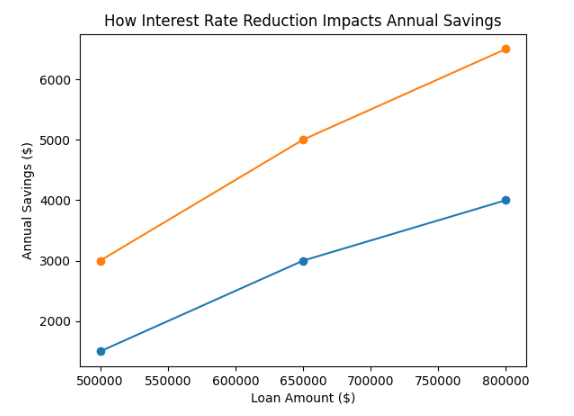
For most borrowers on a mid-sized loan with a rate gap of 0.50% or more, the break-even point lands within 6–12 months. After that, every month is a saving. If you're planning to stay in the property for 3 years or more, as most owner-occupiers are, the numbers usually make a strong case for switching.
Refinancing vs Staying: When Each Makes Sense
Refinancing is not always the right answer. Here's when staying put is the smarter call:
• Selling within 12–18 months: the switching costs won't be recovered before settlement
• LVR above 80%: refinancing may trigger LMI at the new lender, cancelling out any rate savings
• Fixed rate with significant time remaining: always request a break cost figure in writing before making any decision. It can be large enough to make staying cheaper in the short term
• Credit score has dropped: applying while your score is weakened can result in a worse rate, or a decline that further damages the score
Refinancing makes the strongest case when your rate gap is clear, your LVR is healthy, you're not selling soon, and your financial position is stable. The answer is rarely obvious from a single data point; it requires looking at all four.
Beyond the Rate: What Else Refinancing Can Do
Rate is the most common reason to refinance, but not the only valuable one. Borrowers also switch to the following:
• Access equity: if your property has grown in value, refinancing can unlock usable equity for renovations, a deposit on an investment property, or debt consolidation at home loan rates rather than personal loan rates
• Change loan features: gaining access to a proper offset account, removing an annual fee, or switching from principal and interest to interest-only for an investment property
• Consolidate debt: rolling high-interest personal loans or credit card debt into a lower-rate mortgage, carefully structured so short-term debt isn't extended over 30 years unnecessarily
How ASK Financials Handles This for You
At ASK Financials, we start with your current loan rate, balance, LVR, and features and compare them honestly against what's available across our lender panel. We calculate the break-even point before recommending anything and flag the situations where staying is smarter and where refinancing makes clear financial sense. We manage the application and transition so there's no disruption on your end. No broker fee. No unnecessary switching.
FAQ: Will refinancing affect my credit score?
Answer: A single well-prepared application has minimal impact on your credit score. The risk comes from multiple applications in a short period, each of which creates a credit enquiry that lenders can see. Working with ASK Financials means one targeted application to the right lender, not multiple attempts.
The Right Time Is When Your Loan No Longer Serves You
There's no universal perfect moment to refinance a home loan. But there is a clear indicator: when the cost of staying on your current loan exceeds the cost of switching. In 2026, with competitive rates meaningfully below what many loyal borrowers are paying, that calculation is more likely to favour switching than it has been in several years. Run the numbers. Have the conversation. Then decide.
Book a free consultation with ASK Financials to compare your current loan against the market and see exactly where you stand.
Follow ASK Financials onInstagram, Facebook, andLinkedIn for weekly refinancing tips, home loan guides, and mortgage market updates across Australia.