

Is Your Rate Still Competitive? Why Refinancing Is Now Half the Market (and How to Check Your Rate in 10 Minutes)
By Amol Khuntale, Principal Broker at ASK Financials
"Only refinance a home loan if you save 1%." Plenty of borrowers hear this rule of thumb, but it isn't a rule. The real test is how much you could save compared with what it costs to switch, over the time you expect to keep the loan.
It's worth testing now. According to the ABS Lending Indicators release of 11 November 2026, the number of new home loans fell 15.0% in the September quarter 2026, and refinancing can look like a bigger part of the market when new lending falls. The RBA has raised the cash rate five times in 2026. Its most recent increase, of 25 basis points to 4.85%, was announced on 3 November 2026 and took effect on 4 November 2026. The RBA's next decision is scheduled for 8 December 2026. The RBA cash rate is not the rate you pay. According to Moneysmart, lenders set their own home loan rates, which also depend on your credit profile and on competition. A quick mortgage rate check can help you see whether your home loan rate is competitive. This article is general information only, not personal advice.
Why refinancing can look bigger when new lending falls

According to the ABS Lending Indicators for the September quarter 2026 (released 11 November 2026), new home lending fell sharply, and that can make refinancing look like a larger share of all lending even when refinancing itself hasn't grown.
What the ABS September quarter 2026 figures show
According to the ABS Lending Indicators for the September quarter 2026 (released 11 November 2026), the number of new home loans fell 15.0% to 111,878. Their value fell 15.5% to $81,157m, the largest quarterly fall since the series began in the September quarter 2002.
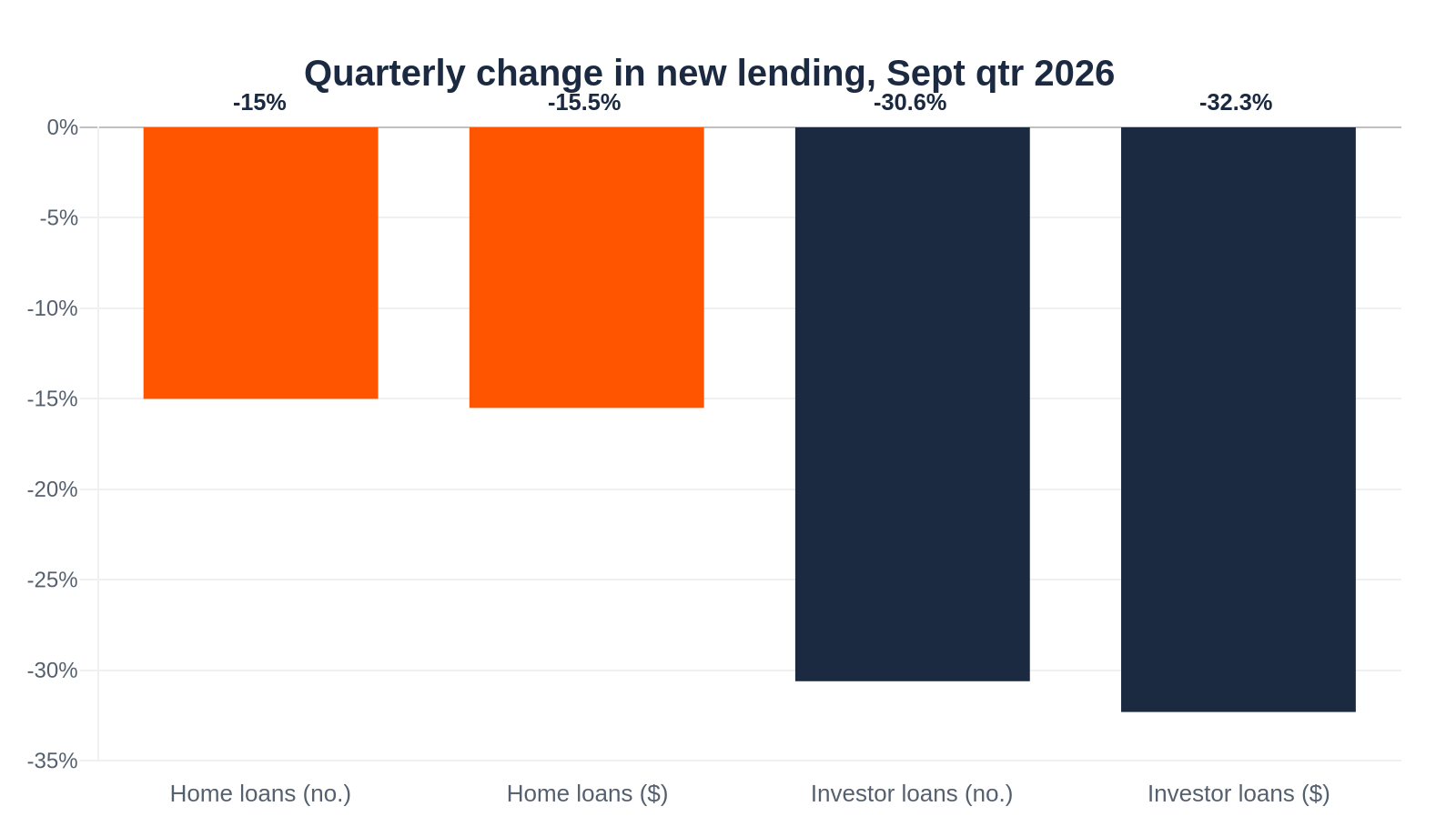
New home lending fell about 15% in the quarter, and investor lending fell about twice as fast. Figures exclude refinancing. Source: ABS Lending Indicators, September quarter 2026 (released 11 November 2026).
According to the ABS Lending Indicators media release of 11 November 2026, new investor loans fell 30.6% to 35,301 in the September quarter 2026, and their value fell 32.3% to $24,705m. The ABS commented that investor activity appears to be influenced by factors beyond higher borrowing costs, including potential tax changes and expectations of lower house prices. Tax rules are general in nature and depend on your circumstances, so confirm them with a registered tax agent.
Source: ABS Lending Indicators, September quarter 2026 (released 11 November 2026). Figures exclude refinancing. For current refinancing figures, see the ABS Lending Indicators release on abs.gov.au.
Internal vs external refinancing: what the ABS actually counts
External refinancing means switching to a different lender. According to the ABS Lending Indicators methodology, an internal refinance occurs where a new loan is obtained to replace an existing loan provided by the original lender and the credit limit has increased, or where the credit limit on an existing loan is increased (for example, a top-up). A simple rate repricing with your current lender, with no increase in the credit limit, may not be counted as an internal refinance. So internal refinancing isn't the same as "switching products".
Always check the denominator when you see a "share of the market" figure. The same number of refinanced loans looks like a much larger share when it is measured against new loans only than when it is measured against all loan commitments, including refinancing.
Why a larger refinancing share wouldn't mean refinancing is booming
According to the ABS Lending Indicators for the September quarter 2026 (released 11 November 2026), the number of new home loans excluding refinancing fell 15.0%. When new lending falls this sharply, refinancing can make up a larger share of all lending even if refinancing itself hasn't grown. A bigger slice of a smaller pie isn't a boom, and the figures say little about what suits any one borrower.
Check your rate in 10 minutes: a step-by-step mortgage rate check
To check whether your home loan rate is competitive, compare what you pay now with lenders' current published rates for your LVR and loan purpose. Then weigh any gap against the cost of switching. Moneysmart notes that variable rates on the market can differ by more than 2%, so a regular review is worthwhile.
LVR (loan to value ratio) is your loan amount as a percentage of your property's value. Lenders commonly use it to set pricing and to decide whether lenders mortgage insurance (LMI) applies.
Have your app or latest statement handy, then work through these steps:
Find your current rate in your lender's app or your latest loan statement.
Note the rate type: standard variable, discounted variable or fixed.
Find your comparison rate (on your loan documents or the lender's website).
Estimate your LVR: loan balance ÷ a realistic current property value (recent comparable sales are a better guide than an old purchase price).
Note your remaining term and repayment type (principal and interest, or interest-only).
List your fees, plus any fixed-rate break costs if you're on a fixed rate.
Compare against current published rates for your LVR band and loan purpose (owner-occupier or investor), looking at comparison rates as well as headline rates.
Run the numbers in the repayment calculator on askfinancials.com.au.
Keep your notes. They also work as your script if you decide to ask your current lender for a review first (more on that below). Moneysmart's "Switching home loans" page is a useful independent checklist.
How to read your rate: headline rate vs comparison rate

A headline rate is the interest rate on its own. Moneysmart defines a comparison rate as a single percentage that combines the interest rate and most fees and charges, to show the true cost of a loan.
The comparison rate points above follow ASIC's National Credit Code guidance.
Standard variable vs discounted variable rates
A standard variable rate (SVR) is a lender's base variable rate. A discounted variable rate is usually the SVR less a discount, which may be ongoing or limited-time. The ACCC's Home Loan Price Inquiry (interim report, 30 March 2020) found that headline rates often don't reflect the rates most borrowers actually pay, because of discretionary discounts. Ask what your discount is and whether it applies for the life of the loan.
Why the comparison rate matters
A comparison rate combines the interest rate and most fees and charges into a single percentage, so two loans with the same headline rate can have different comparison rates (Moneysmart). Lenders set their own rates and change them often, so check each lender's own page on the day you compare.
How your LVR and loan purpose change the rate you're offered
Lenders may price by LVR band, and the cut-offs vary by lender. Lenders mortgage insurance (LMI) usually applies when you borrow more than 80% of the property value (Moneysmart). Pricing can also differ between owner-occupier and investor loans, and between principal and interest and interest-only. With interest-only, the debt doesn't reduce during the interest-only period, total interest is higher and repayments rise when the period ends (Moneysmart). When you compare rates, make sure each one matches your LVR band and loan purpose.
The loyalty tax: why older loans can cost more
A "loyalty tax" on a mortgage means existing customers may pay more than new customers for the same product. According to the ACCC's Home Loan Price Inquiry interim report (30 March 2020), the big four banks' focus on attracting new home loan customers with increasingly large discounts created a difference between the average interest rates paid on new loans and on existing loans. In practice, lenders' older loans (the "backbook") can drift to higher rates while lower pricing is offered to attract new borrowers.
Chapter 6 of the House of Representatives Standing Committee on Economics report on its inquiry into promoting economic dynamism, competition and business formation (Parliament of Australia) describes the higher rates paid by long-standing mortgage customers as, in effect, a "loyalty tax", and refers to the ACCC's 2020 home loan inquiry.
What the ACCC found about older loans
The ACCC's Home Loan Price Inquiry found:
Interim report (30 March 2020): as at 30 September 2019, big four customers with owner-occupier principal and interest loans older than five years paid on average 40 basis points (0.4 percentage points) more than big four customers with new loans.
Final report (December 2020): as at September 2020, borrowers with loans three to five years old paid on average about 58 basis points more than the average rate paid on new loans. Borrowers with loans more than 10 years old paid about 104 basis points more.
The ACCC said that a borrower with a loan of around $250,000 who switched to a rate 58 basis points lower could save more than $1,400 in interest in the first year. The ACCC also found that borrowers with loans older than about three years could benefit from seeking a better deal from their current lender or switching.
These are historical findings, and today's gap may differ. Your own rate review will show where you sit now.
Ask your current lender for a better rate first

Asking your current lender for a rate review may not involve switching fees, which is why many borrowers start here. The ACCC's Home Loan Price Inquiry final report (December 2020) found that borrowers with loans older than about three years could benefit from seeking a better deal or switching.
A simple script for a rate review
Have these points ready when you call or message your lender:
"My current rate is [X]% on a balance of about [$Y]."
"My LVR is roughly [Z]%, based on [recent comparable sales or a recent valuation]."
"I've kept up my repayments on time for [N] years."
"I've seen a published rate of [X]% for a similar LVR band and loan purpose elsewhere."
"Can you review my rate, and tell me the comparison rate and any fees?"
What to compare when they come back with an offer
The comparison rate and fees, not just the headline rate.
Whether the discount is ongoing or for a limited time.
Any change to features, such as an offset account or redraw.
The offer in writing, so you can compare it with other options.
If the offer doesn't narrow the gap, an external refinance may be worth weighing against the costs below.
Myth busted: is refinancing worth it for a 0.5% saving? A hypothetical $600k example
Is refinancing worth it if I only save 0.5%? It could be, depending on the loan size, the switching costs and how long you keep the loan. The "1% rule" ignores all three.
The example below is hypothetical and illustrative, not a quote or an offer. It assumes a $600,000 loan, 30-year principal and interest, monthly repayments. The rates are examples only and don't refer to any lender.
The monthly and annual difference
ASK calculations, rounded. Monthly figures use the standard repayment formula. The $1,200 switching cost is hypothetical.
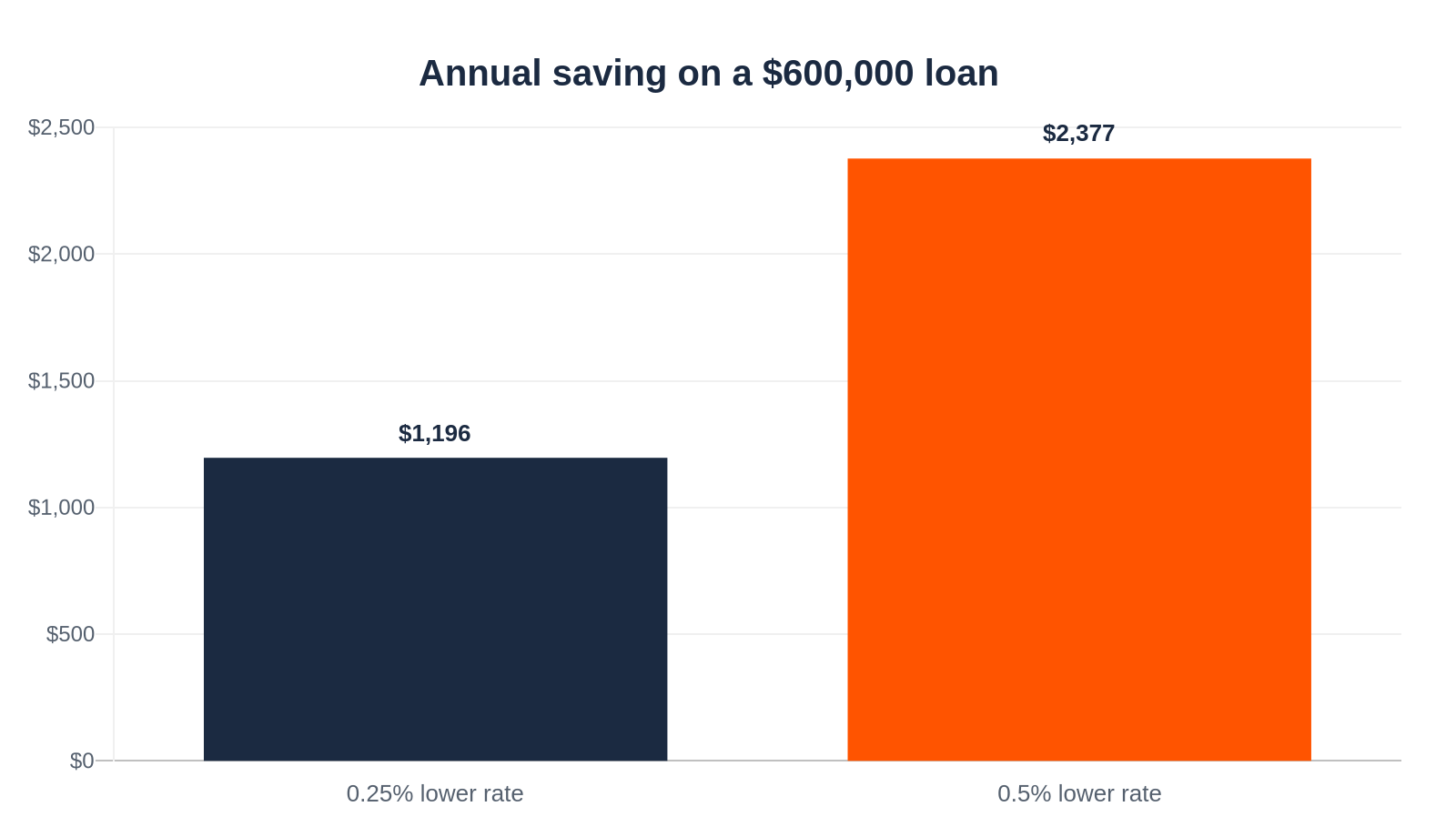
Even a 0.25% gap is worth about $1,196 a year on this hypothetical loan. Source: Illustrative example from this article (ASK calculations, rounded).
On this hypothetical, a 0.5% gap is roughly $198 a month, or about $2,377 a year. A smaller 0.25% gap still comes to about $100 a month. That shows why a fixed 1% threshold can mislead on a larger balance.
Breakeven: how fast the switching costs could be covered
If hypothetical switching costs were $1,200, dividing by $198 gives a breakeven of about six months. At a 0.25% gap, it is about twelve months. If you expect to keep the loan for several years, the maths could look different than if you plan to sell soon. Your own costs and timeframe will change the result.
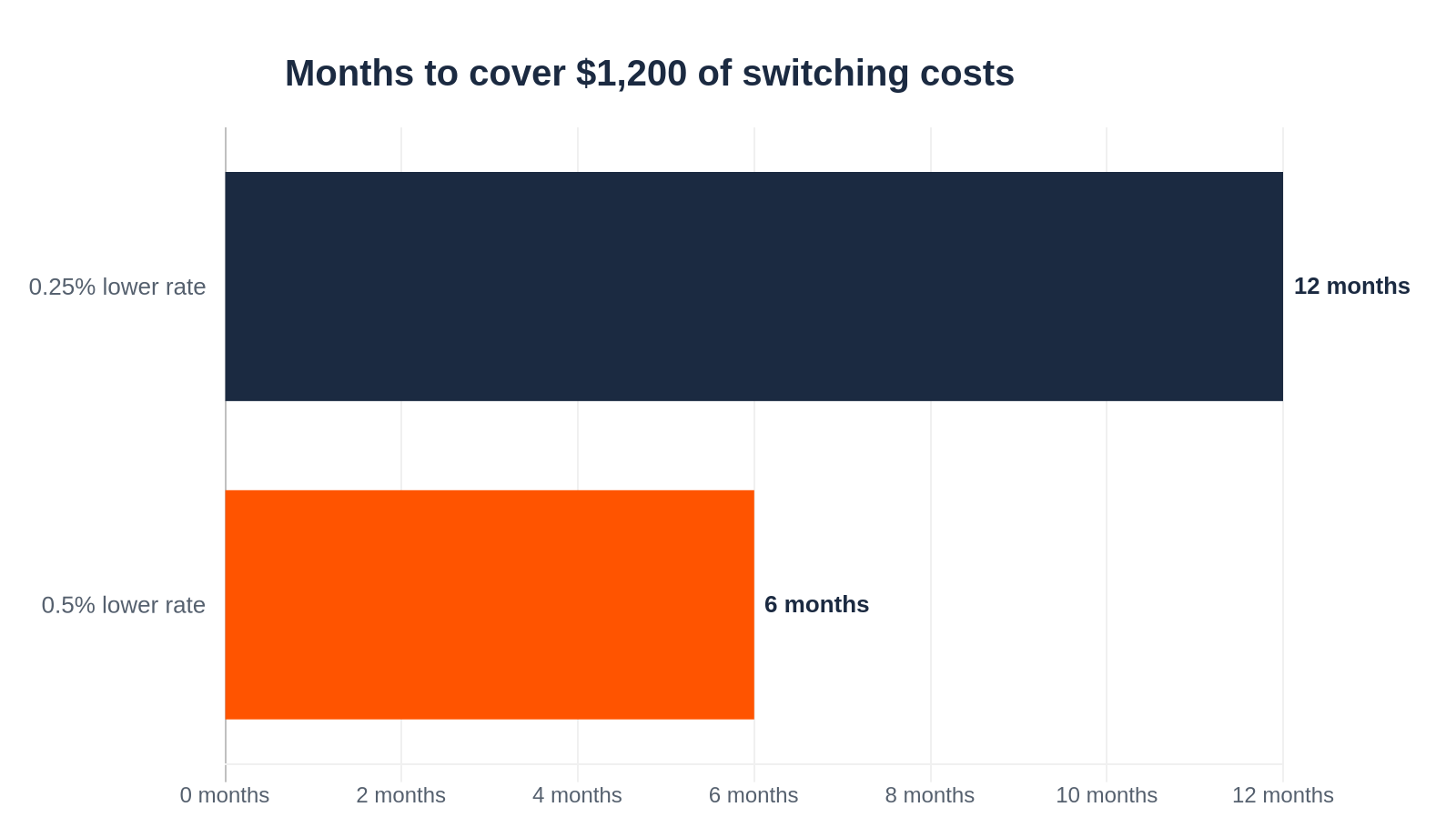
A bigger rate gap covers the switching costs sooner. Source: Illustrative example from this article.
Why a "lower rate" can still cost more: term resets and fees
Term resets: Suppose you have 25 years left at 6.84% (about $4,180 a month on $600,000). Refinancing into a new 30-year term at 6.34% lowers the repayment to about $3,730. But total interest could be roughly $89,000 higher (ASK calculation, hypothetical). A lower repayment isn't always a lower cost.
Fees: Ongoing fees, or a higher comparison rate, can erode a headline saving.
Lost features: An offset account is a transaction account linked to your loan, and its balance reduces the amount of the loan that is charged interest (Moneysmart). Losing one could wipe out a rate gain.
Test your own numbers in the repayment calculator on askfinancials.com.au.
Not sure where you stand? Book a free strategy call with ASK Financials.
Refinance home loan costs: the true cost of switching

Switching can involve several costs, and they vary by lender and by situation. Confirm each with your lender before deciding. No dollar amounts are quoted here because current fees must be checked.
Lender fees: discharge, application and valuation
Ask each lender for a full fee list in writing. Any cashback on offer may reduce your net cost, but check the conditions. The comparison rate won't capture every one-off cost.
LMI if your LVR is over 80%
Moneysmart explains that LMI protects the lender, not the borrower, if the borrower can't repay. It usually applies when you borrow more than 80% of the property value, and it is typically a one-off cost paid at settlement or added to the loan. If a refinance would leave you above 80% LVR, ask the new lender for an LMI quote before you commit.
Fixed-rate break costs
Fixed loans may charge break fees if you switch, sell or repay early (Moneysmart). The comparison rate excludes government fees and charges that apply only in certain circumstances, such as early repayment, so ask your lender for a break cost estimate.
Government fees and charges
Government fees and charges may apply when a mortgage is registered or discharged. They vary, so ask your lender for the current amounts in writing.
Two hurdles to check before you refinance a home loan: LVR and serviceability
Two things can change the outcome of a refinance: your current LVR and whether you pass a new lender's serviceability test.
Refinancing when your property value has dropped
Can I refinance if my home value has fallen? Possibly, but a lower valuation raises your LVR, which could change your pricing.
Take a hypothetical $600,000 loan:
At an $850,000 valuation, the LVR is about 71%.
At $800,000, it is 75%.
At $740,000, it is about 81%, where LMI may apply.
Bands and policies vary by lender. According to the ABS Total Value of Dwellings release of 8 September 2026, the national mean price of residential dwellings fell by $8,200 to $1,100,400 in the June quarter 2026. National averages don't describe your street, so Melbourne borrowers weighing a refinance may get a better guide from recent local comparable sales and the lender's valuation.
Automated vs full valuations
Some lenders use automated valuations, while others order a full valuation by a valuer. Outcomes depend on lender policy and valuation method. You could ask whether a full valuation is possible if an automated figure looks low, and compare it with recent sales near you.
Will you pass serviceability at today's rates?
Serviceability is a lender's assessment of whether you can afford the repayments. A new lender will reassess your income, expenses and debts. Under APRA's prudential standard APS 220 (effective 1 October 2021), banks must assess new home loan borrowers' ability to repay at an interest rate at least 3 percentage points above the loan product rate. This is often called the serviceability buffer. Hypothetically, a loan at 6.84% could be assessed at 9.84%. With the cash rate rising in 2026, a loan that passed years ago may not pass today.
Since 1 February 2026, APRA has also limited banks (ADIs) to writing no more than 20% of new mortgage lending at a debt-to-income ratio of 6 times or more, measured separately for owner-occupier and investor lending. APRA says this limit applies to ADIs rather than non-bank lenders. If your total debt is high compared with your income, ask any lender how this applies to your refinance.
Undisclosed or forgotten debts, such as credit card limits and buy-now-pay-later accounts, can reduce borrowing capacity. Self-employed borrowers may face extra documentation, and a broker can help with this.
Before you switch, check:
Your realistic current property value (recent comparable sales) and resulting LVR.
Your lender's LVR pricing bands, and whether you are near a cut-off.
Whether LMI could apply above 80% LVR.
Which valuation method the new lender uses.
Your income, expense and debt documents.
Your repayments tested at the assessment rate (current rate plus 3 percentage points) using the borrowing power calculator on askfinancials.com.au.
How a broker can help with a rate review

A broker can help you work through the steps above, but the decision stays yours. We can compare options from our lender panel, assess LVR bands and serviceability, and look at the whole structure (offset, redraw, term and cash flow), not just the rate.
The service is free to clients because the lender pays the broker. According to ASIC's guidance, because lenders typically pay brokers commissions, this can create conflicts of interest, which the best interests duty addresses. Under the National Credit Act (s158LA and s158LB), brokers must act in your best interests when providing credit assistance and put your interests first if there is a conflict. ASIC's report REP 840 (13 October 2026) also indicates it is unlikely to be in a consumer's best interests for a broker to recommend a loan when a cheaper one meeting the consumer's non-cost needs is available.
Investors can also use the Property Cash Flow Analyser (cashflow.askfinancials.com.au). Tax and deductibility questions after refinancing are general in nature here, so confirm them with a registered tax agent.
Book a free strategy call for a rate review.
Key takeaways
Refinancing can look like a larger share of lending when new lending falls, as it did in the September quarter 2026 (ABS Lending Indicators, 11 November 2026).
Compare comparison rates, not just headline rates.
Long-standing loans have historically paid more than new loans (ACCC, 2020), so a mortgage rate check is worthwhile.
Asking your current lender for a review first is one option some borrowers consider.
Weigh any saving against the cost of a home loan refinance over the time you'll keep the loan, rather than a "1% rule", and check your LVR and serviceability before paying switching costs.
If you'd like a second set of eyes, book a free strategy call with ASK Financials.
Frequently asked questions
Is refinancing worth it if I only save 0.5%?
It could be, depending on your loan size, switching costs and how long you keep the loan. On a hypothetical $600,000 loan, a 0.5% gap is roughly $198 a month, so $1,200 in costs could be covered in about six months. Fees, term resets or lost features could change that.
How much does it cost to refinance a home loan in Australia?
Costs vary by lender and situation. They may include discharge, application and valuation fees, LMI if your LVR is over 80%, fixed-rate break costs and government fees and charges. Confirm current amounts with your lender, and ask for them in writing before you decide.
Can I refinance if my home value has fallen?
Possibly, but it depends on lender policy. A lower valuation raises your LVR, which could move you into a higher pricing band or, above 80%, trigger LMI. A new lender will also reassess your income and expenses. Ask which valuation method they use and whether a full valuation is possible.
How do I ask my bank for a better interest rate?
Contact your lender and say you're reviewing your rate. Give your current rate, LVR, repayment history and a competing published rate for your LVR band. Then compare any offer on the comparison rate, fees and whether the discount is ongoing. A rate review may not involve switching fees.
What is the difference between internal and external refinancing?
External refinancing means switching to a different lender. Under the ABS methodology, internal refinancing is a new loan from the same lender that replaces an existing loan where the credit limit has increased, or an increase to the credit limit on an existing loan, such as a top-up. A simple rate repricing with your current lender, with no increase in the credit limit, may not be counted as an internal refinance.
About the author
Amol is a Melbourne mortgage broker and former ANZ director, qualified in mortgage broking, accounting and financial planning. He was named Metro Broker of the Year 2026 at the BIA Awards.
Checked against official Australian sources, including the Reserve Bank of Australia.
Last updated: 15 November 2026
General information only. This article does not take into account your objectives, financial situation or needs. Consider whether the information is appropriate for you and seek personalised advice before acting. Tax information is general in nature; speak to a registered tax agent about your circumstances. Lending criteria, fees and charges apply. ASK Financials (ABN 48 661 070 962) is Credit Representative 543187 authorised under Australian Credit Licence 389087.
