

Negative Gearing Explained: What It Means & Is It Worth It?
In the world of Australian property investment, few terms spark as much discussion as negative gearing. It's a strategy that can proficiently shape an investor's financial future in a certain manner, but it's often misunderstood. At its core, negative gearing is a simple concept: it is what happens when the income generated by an investment, such as a rental property, is less than the expenses associated with it. While the result might resoundingly be clear, like an undesirable outcome, the key truly lies in the potential tax benefits and the long-term goal of capital appreciation. At ASK Financials, we believe that making well-informed decisions is the principal key to building a sustainable financial future. This article basically aims to demystify negative gearing, explaining what it means, how it works, and whether it's the right choice for your investment portfolio.
What Exactly Is Negative Gearing?
Negative gearing occurs when the annual expenses of owning an investment property—namely mortgage interest, council rates, maintenance, and, above all, property management fees—are higher than the rental income it generates. This results in a net loss. While this might seem counterintuitive, the real benefit lies in the tax system. The investor willingly accepts a short-term cash flow deficit in anticipation that the property's value will increase significantly over time, more than compensating for the annual losses. This long-term perspective is quite crucial, since the goal is to build substantial equity and ultimately make a profit upon the sale of the asset.
For instance, simply imagine your investment property generates nearly $30,000 in annual rent, but your expenses—primarily loan interest—total $35,000. This creates a $5,000 loss. If your taxable income from your job is $80,000, you can reduce this amount by the $5,000 loss, meaning you only pay tax on $75,000. This strategy is basically based on the expectation that the property's value will increase over time, and the long-term capital gain will more than compensate for the short-term losses.
The Pros and Cons of Negative Gearing
While negative gearing offers a compelling tax advantage, it is not without its risks and considerations. A balanced understanding is very essential for any potential investor.
The Advantages:
Tax Efficiency: The prime benefit is the ability to offset the annual investment loss against your personal income, which can lead to a significant tax refund. This is particularly beneficial for high-income earners.
Leveraging: Negative gearing greatly allows investors to use borrowed money (a mortgage) to control a high-value asset, thereby amplifying potential returns from capital growth.
Asset Accumulation: It enables investors to build a property portfolio that they might not otherwise be able to afford, accelerating their wealth-building journey.
Passive Income Potential (Eventually): While a property may start out negatively geared, over time, as rent increases together with the mortgage being paid down, it can transition into a positively geared asset, generating a net profit.
Portfolio Diversification: Negative gearing can be a way to construct a diversified property portfolio, spreading risk across different locations and property types.
Potential Risks:
Negative Cash Flow: The most immediate challenge is the need to cover the shortfall between rental income and expenses. This basically requires a stable income and a disciplined financial buffer to manage ongoing costs.
Market Fluctuations: If the property market stagnates or declines, you could be left with both a negative cash flow and no capital growth to offset your losses.
Reliance on Capital Growth: Negative gearing is a high-stakes gamble on the future. If the property's value does not increase—or worse, decreases—the investor is left with a consistent financial loss and no capital gain to offset it.
Interest Rate Fluctuations: An increase in interest rates can dramatically raise mortgage repayments, worsening the negative cash flow position & putting financial strain on the investors.
Market Volatility: The property market is subject to economic cycles. Downturns can lead to falling property values and stagnant or declining rents, simply making a negatively geared investment a significant financial liability.
Key Statistical Trends in the Australian Property Market
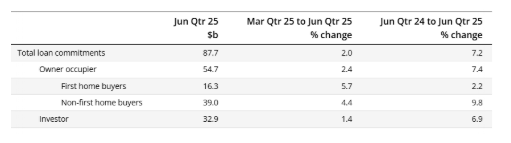
Understanding the broader market landscape is critical when considering a negatively geared investment. The performance of a property is heavily influenced by a significant layer of economic indicators, including investor lending and home value trends. This trend clearly suggests that while investors were active, first-home buyers and owner-occupiers played a significant role in driving market activity.
Source: Australian Bureau of Statistics (ABS)
This data reveals that while owner-occupier commitments saw a greater quarterly change, investor commitments also demonstrated solid growth, indicating continued confidence in the property market. This growth in investor activity is a key driver of demand, which in turn influences prices and rental yields—two essential components of the negative gearing equation.
Final Thoughts: Making an Informed Decision—Why Partner with ASK Financials?
Negative gearing can be a powerful wealth-building tool, but it's essential to enter the market with a clear, proficient strategy and, above all, a professional team behind you. It's about making a calculated investment that strictly aligns with your long-term financial goals. The decision to negatively gear a property should always be part of a well-defined, long-term strategy. It basically requires a thorough understanding of your personal financial situation, a realistic assessment of market trends, and a clear vision for your investment goals.
Call now at 0433-944-055 or book your free consultation call with the financial experts from ASK Financials to discuss your investment goals and find out if negative gearing is the right path for you.