
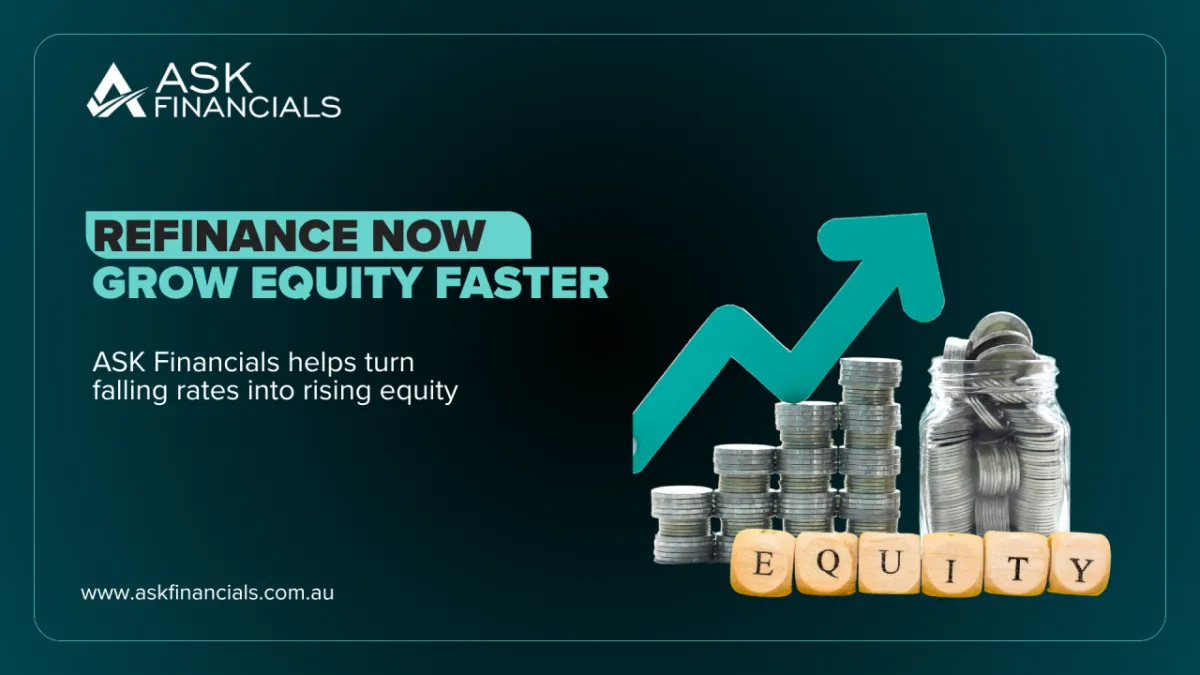
How Refinancing in a Falling Rate Market Helps Investors Build Equity Faster
The Australian finance and property world, along with its accompanying landscape, has changed quite a bit in recent months. With the Reserve Bank of Australia gradually shifting its position on interest rates, borrowers are beginning to enjoy some respite. Of course, lower interest rates bring relief for homeowners and investors, but there is a more calculated opportunity that stands out – building equity faster through timely refinancing.
“Refinancing” often refers to lowering the interest rate associated with a home loan. If done correctly, it can become a fantastic tool for unlocking property equity, increasing borrowing capacity, and enabling future investment pathways. As a lender, we at ASK Financials have seen how all our clients, whether they are first-time investors or seasoned portfolio builders, take advantage of this precise moment to reshape their wealth strategies.
The Foremost 4 Benefits of Practicing Refinancing Loans in a Decreasing Rate Environment
Refinancing in a falling rate environment can be more than just brilliant, depending on a person’s financial habits; it can also enable simultaneous wealth generation, equity building, and catalyzing new economic avenues.
1. Enhanced Equity Accumulation
Declining interest rates enhance principal repayment through loans. This not only helps pay off the loan amount rapidly but also accelerates equity value accumulation. This becomes particularly helpful for real estate investors who acquire their properties through leveraging equity.
2. Better Loan Product
Traditional loan products often offer rigid term limits and drawdown facilities. Such limitations are done away with, at least when it comes to modern loan products. The removal of such limitations opens the doors to more advanced loan products with features like offset accounts, redraw facilities, cash flow management, blanked interest loans, and even interest-only drawdowns, which work spectacularly for debt-to-equity investment strategies.
3. Boosted Cash flow
Also known as disbursed expenditure, reduced monthly repayments allow borrowers to redesign their budgets and allocate previously fixed malleable budget portions to boosting savings, paying old debts, funding deposits, or even paying off property renovations. In essence, it enables the borrower to get ahead financially.
4. Increased Borrowing Capacity
Furthermore, lower interest rates coupled with higher equity improve your Loan-to-Value Ratio (LVR). This is reasonable for your next desired property. In addition, better serviceability, along with increased equity, strengthens loan approval odds.
What Equity Means in Greater Context, and Why It Is of Importance
Equity is never just a figure. In real estate investing, equity represents one of the most potent assets one can possess. It means a home’s value against the outstanding mortgage amount.
Your equity increases with each repayment or appreciation in your property’s value. However, there is no need to delay this for many years. During declining interest rates, refinancing translates to lower repayment portions going towards interest. That shift accelerates the repayment pace towards equity with no increase in monthly costs.
With increased equity, one can purchase an additional property, refinance under more favorable terms, or renovate the existing property. This is all about optimizing available assets and leveraging them for plans.
Why Lower Interest Rates Matter So Much
A reduction in interest rates leads to reduced repayment amounts on loans. The opposite is true for seasoned investors, as they tend to maintain their payments at the same level. The upside is that they benefit since a larger proportion of the loan now gets a principal write-down.
The pace of acceleration in equity growth driven by these slow efforts is substantial.
Imagine you borrowed money when interest rates were high at 6.5%. If you now refinance to 5.1%, you have increased your financial ease. If you preserve the initial repayment amount, your balance reduces more rapidly. This means you increase your equity earlier than expected.
Equity provides benefits beyond aesthetics. It enhances the loan-to-value ratio, increases the ability to borrow, and gets you closer to the next investment.
Looking Ahead: Structuring a Portfolio with Strategic Refinancing.
Most people see refinancing as a line of credit to a lower-paying loan, but for serious investors, refinancing offers strategic long-term value. The compounding advantages of refinancing continue to increase with time, and it can raise equity if a lower interest rate is used over the long term, along with a disciplined repayment strategy. The total amount accessed could be hundreds of thousands of dollars.
Equity that has been built over time can be leveraged as an effective jump-off point to acquire your next property or even to build a diverse investment portfolioSpeaking of comprehensive strategies, modern refinance products have come with features that are designed to maintain the level of flexibility and streamline processes to ensure clients get the most favorable outcomes. Products that allow you to pay off your loan without sustaining fees to reduce interest charges and permit you to access repaid extras when desired all assist in building a flexible approach to accessing funds. Improved cash flow, along with rising equity, can be achieved simultaneously when these tools are utilized alongside falling interest rates.
Timing Matters
Investors waiting too long to refinance is one of the primary blunders many make. The opportunity to lower borrowing costs comes with the economy stabilizing or during periods of rising inflation; this results in a closing window of opportunity. In other words, falling rates don’t last forever.
At the moment, a considerable portion of Australian property borrowers are sitting on loans that are 1-2% above the current market rate for similar loans. If you identify with that segment, you’re not only losing money over what you owe on your loans but also missing out on the opportunity to accelerate equity growth.
Improve your business position without adding to your monthly expenses with a refinance in a falling interest rate market. By keeping your payment level and reducing your loan rate, you are increasing your business equity at a faster pace. That business equity doesn’t just sit there; it can be converted to real options such as a second property, upgrading your current one, or simply acting as a cushion for hard times in the future.
You can be significantly ahead of your competition by taking action instead of waiting for the next rise in interest rates or a change in market conditions. While these properties are not as easily accessible to everyone, timing is crucial for those who are seeking to invest. Once the right conditions are met, being proactive can lead to instant results. A well-timed refinance can make what seemed impossible possible and remove a lot of heavy burdens off your chest.
Here at ASK Financials , we make it a point to not only assist clients on the refinance journey but also to help them navigate a suitable financial roadmap that is tied to property milestones with targeted refinancing timelines. From knowing when the right time to access equity is to how the next loan should be structured, refinancing tools become part of the comprehensive investment strategy. We help you compare, choose, and give guidance in refinancing at the lowest possible rate. Contact Us at 0433 944 055/Book Your FREE Consultation Today to get the right loan without the hassle and delay.