

Are First-Home Buyer Grants Really Helping or Just Inflating Prices?
Australia's housing market has long been a prime topic of fervent discussion, particularly for first-time buyers trying to break through the significant barrier of entry. Government initiatives, such as the First Home Buyer Grant (FHBG) and the broader Home Guarantee Scheme, were introduced with the noble intention of making the wonderful Australian dream of homeownership more accessible. On the surface, these initiatives seem like a clear win. They offer a financial leg-up, a much-needed boost to a deposit, and a beacon of hope in a competitive market. Moreover, a closer look reveals a more complex reality. The question is, are these grants truly achieving their intended purpose of improving affordability, or are they inadvertently fueling the very problem they were created to solve by pushing up house prices?
This is a critical question for anyone entering the property market, and it basically requires a brief understanding of market dynamics, as well as the right professional guidance. As a trusted mortgage broker firm, ASK Financials understands this dilemma and is dedicated to helping clients navigate this intricate landscape with personalized advice and strategic solutions. We believe finance should be empowering, not overwhelming, and help the first-time buyers make confident decisions and build long-term financial freedom.
The Intention Behind the Grants
The primary goal of first-home buyer grants is to stimulate the housing market as well as assist individuals who would otherwise struggle to save the necessary deposit. By providing a lump sum of money, these grants reduce the initial barrier to entry, making homeownership a more immediate possibility for a wider demographic. The psychological effect is significant: it provides a sense of security and stability to those who have been saving diligently for years. In a low-supply market, where a 20% deposit can amount to hundreds of thousands of dollars, a grant of $10,000 or $20,000 can be the difference between a rental and a mortgage.
Furthermore, these schemes can be targeted. Some grants are specifically for new constructions, aiming to boost housing supply and, above all, support the building industry. Others are for existing homes, mainly designed to facilitate movement within the market. These policies are strictly crafted with the best intentions, but their real-world impact is often subject to market forces that can be difficult to control.
The Double-Edged Sword of Financial Assistance
Government schemes are designed to create opportunity, but their effectiveness can be a subject of intense debate. For instance, recent expansions to schemes like the The Home Guarantee Scheme has been welcomed by many for increasing property price caps as well as removing income limits, theoretically opening the door to a wider range of buyers. Indeed, this has also led to market commentary from economists who warn of increased buyer competition, which could push prices even higher.
The mechanism is straightforward: a grant effectively increases a buyer’s borrowing power or deposit size. This truly allows them to bid on properties at a higher price point than they could previously afford. When a large number of buyers enter the market with this newfound capacity, competition for homes truly intensifies. Consequently, sellers can command higher prices, and the market equilibrium shifts upwards. In essence, the grant money often doesn't reduce the total cost of a home; it simply gets transferred from the government to the seller in some manner via the inflated purchase price.
Positive Impact: For an individual, a grant can mean the difference between buying and not buying. It can reduce the time spent saving for a deposit and provide access to a more secure financial future.
Negative Impact: For the proficient market as a whole, widespread grants can contribute in many unique ways to systemic price inflation, truly making the housing market even more inaccessible for the next generation of first-home buyers.
Statistical Insights into First-Home Buyer Activity
To truly understand the impact of these schemes, we must look at the data. While the cause-and-effect relationship between grants and prices is often debated, statistics on lending as well as property commitments can provide holistic valuable insights. The Australian Bureau of Statistics (ABS) provides a clear picture of lending trends.
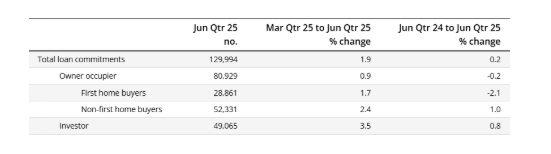
Source: Australian Bureau of Statistics (ABS)
This data shows that while overall loan commitments grew moderately, the number of new loan commitments specifically for first-home buyers rose by 1.7% in the quarter. This primary increase in first-home buyer activity, while modest, highlights their continued presence in conjunction with appetite in the market, even as other segments experienced more subdued growth.
End Thoughts: The Final Verdict and a Professional Solution
The journey to buying a first home is complex, filled with both exciting opportunities and potential pitfalls. While first-home buyer grants are a significant part of the landscape, understanding their full impact is crucial for making a wise investment. As a result, first-home buyer grants are a tool, and like any tool, their effectiveness depends on how they are used. In isolation, they may cause market distortions. But when combined with a resoundingly clear financial strategy and expert guidance from a firm like ASK Financials, they can be a powerful catalyst for achieving the dream of homeownership. The grant alone won't solve the affordability crisis, but it can be the starting point for a successful and stable financial future.
Call now at 0433-944-055 or book your free consultation call and take the very first step toward a smarter, more strategic path to homeownership.