

In a Mixed 2026 Market, Borrowing Strategy Matters More Than Suburb Choice
In a Mixed 2026 Market, Borrowing Strategy Matters More Than Suburb Choice.
The Australian property market in 2026 is not doing well across all states and price ranges. Recent data on housing and lending trends show that prices, buyer demand, and the ability to borrow money are no longer in sync across the country. On the other hand, some parts of Sydney and Melbourne have seen prices level off after earlier rate hikes. At the same time, some regional centres with strong population growth and a limited supply of housing are keeping their values.
Analysts call this a "mixed market" because prices and buyer demand are not moving in the same direction. Growth is not widespread, and results can be very different depending on where you are, how much you pay, and how easy it is to borrow money.
In such an environment, it can be misleading to only think about which suburb to invest in.
Your borrowing strategy, loan structure, and how well your finances match up with current market conditions are often more important.
At ASK Financials, we’re seeing a clear shift in borrower priorities in 2026. Making smart financial choices can be more important than picking the right postcode.
What Does a Mixed Market Actually Mean?
In 2026, the Australian property market is clearly doing better in some places and with some types of properties than others. Recent housing data shows how uneven this cycle has become.
For example:
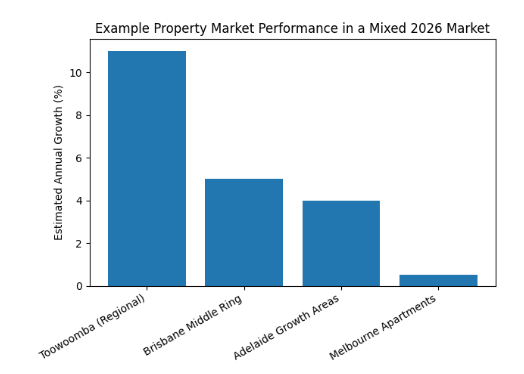
Some affordable regional centres, such as Toowoomba, have recorded price growth of around 10–12% in the past year.
There is still steady buyer demand and moderate price increases in some middle-ring suburbs in Brisbane and Adelaide.
In the meantime, some parts of Melbourne's apartment market have remained flat since the interest rate cycle started to tighten.
At the same time, lending conditions have changed significantly. Compared to the very low interest rates of 2021, many borrowers can now have their borrowing capacity reduced by 25–30% because interest rates are higher and serviceability buffers are stricter.
This combination of uneven price performance and tighter lending conditions is what analysts refer to as a mixed market environment.
Recent lending data and property research from organisations like CoreLogic, the Australian Bureau of Statistics (ABS), and the Reserve Bank of Australia (RBA) show that borrowing conditions and property prices are changing in different parts of the regions.
Why Borrowing Strategy Now Matters More
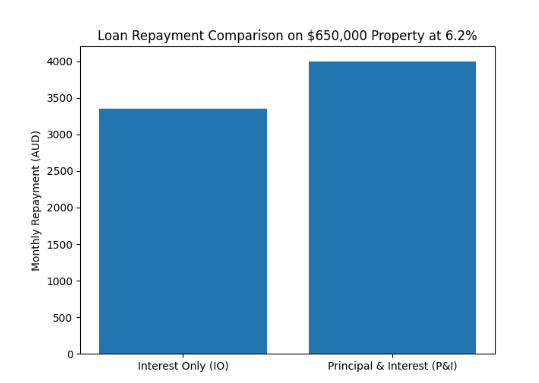
Consider two investors purchasing a $650,000 investment property.
Investor A chooses an interest-only (IO) loan structure for the first five years to keep payments low and cash flow strong.
Investor B chooses a principal-and-interest (P&I) structure immediately without looking at their overall investment strategy.
At an interest rate of 6.2%:
The IO payment could be around $3,350 a month.
The P&I repayment could be closer to $4,000 a month.
That difference of about $650 a month can have a big effect on an investor's cash flow and ability to handle rising costs.
In a mixed market where growth isn't certain, having flexible cash flow can mean the difference between holding onto an asset comfortably or having to sell it early.
The Investor Mindset Shift Happening in 2026
For many years, property conversations focused on one question:
"Which suburb will grow the fastest?"
But this time around, experienced investors are asking a different question:
"What kind of loan structure would help me invest for the next five years?"
The difference between these two questions can have a long-term effect on the success of a portfolio.
Suburbs affect how much an investment can grow, but the borrowing strategy decides how long an investor can keep the asset and keep making wealth.
Loan Structure Investors Should Understand
Not all property loans are structured the same way, and the way they are structured can influence long-term investment outcomes.
Some important strategies that investors often consider include:
Interest-only vs principal-and-interest loans
An interest-only loan may help with short-term cash flow, while P&I reduces debt faster.
Standalone Loan Structures
Many experienced investors stay away from cross-collateralisation because it can limit flexibility when they sell or refinance their properties.
Offset accounts vs redraw facilities
An offset account can lower interest costs while keeping money available for future investments.
Equity Access Strategy
As property values increase, structured equity access can help investors save money for future purchases.
The Cost of Getting Financial Wrong
Small mistakes in finance can have big effects in a mixed market.
If your home loan interest rate is 0.50% above what you need, a loan of $800,000 for an investment loan would mean the following:
Thousands of extra interest payments every year.
Less equity-building capacity.
Reduced ability to borrow in the future.
On the same note, when you cannot be flexible with your loan structure, like an offset system or repayment planning, you might have a hard time during times of slower growth.
Smart mortgage strategy planning is a way to make sure that your investment is not crippled by your finances.
Interest Rates and Cash Flow, Risk Management
With interest rate updates and economic adjustments being made, risk management is crucial.
In a mixed 2026 market:
Some areas may be supported by rental growth to help the cash flow.
Other people may be challenged by slower capital growth.
Inventory expenses are more important than ever before.
A good cash flow strategy enables investors to maintain good assets during the weaker times rather than selling them.
We help clients set up their finances at ASK Financials so they are ready for both times of growth and times of consolidation.
It’s Not Location vs Finance; It’s Finance First
Location still matters. Good fundamentals like infrastructure, employment centres and population increases are still significant.
In 2026, however, your borrowing strategy gives the following:
How easy it is for you to hold the property.
If you can refinance in a smart way.
How fast you can add to your portfolio.
How well you can handle changes in the market.
Structured finance is necessary to keep even a good suburb from becoming a financial burden.
How ASK Financials Supports Investors in 2026
We are interested in developing finance strategies that can perform under different market conditions at ASK Financials.
We help clients with:
Detailed borrowing capacity assessment.
Considering the existing home loan interest rate.
Organising loans to achieve long-term portfolio growth.
Strategic mortgage refinancing Australia.
Enhancing the cash flow management in general.
We don't react to market noise; instead, we build a financial structure that works in both strong and mixed markets.
Concluding: Structure Before Suburb
As a mixed 2026 property market, the choice of a suburb is no longer enough.
Your success depends on how you plan your investment loan strategy, loan structure, and cash flow.
When you are reviewing a purchase, refinancing, or looking at your next investment step, it is time to analyse whether you have a solid financial plan that can deal with current conditions.
Get in touch with ASK Financials for a personalised look at your mortgage structure and borrowing strategy. We'll help you clearly understand your options and align your finances with your long-term goals.
Book your consultation. And follow ASK Financials on Facebook, Instagram and LinkedIn to get the latest news on interest rate updates, market trends, and helpful mortgage tips for Australian investors.