

Cheaper Homes, Harder Loans: Why Borrowing Capacity Fell Faster Than Prices (and What Waiting Could Cost You)
By Amol Khuntale, Principal Broker at ASK Financials
With house prices falling (Cotality's Home Value Index shows Melbourne dwelling values down 6.2% over the year to 30 September 2026), many buyers assume their borrowing capacity must be rising. In 2026, with the RBA raising the cash rate five times, it can go the other way for some buyers. If you're asking "should I wait to buy a house?", the numbers below show why a lower price tag doesn't always mean a bigger loan limit.
The myth: "If prices keep falling, I'll be able to afford more"
The fact: your loan limit can shrink faster than the price tag
Buyers often start with the property price and work backwards. Lenders usually work the other way. They start from your income, expenses, debts and the interest rate they use to test your repayments. According to the RBA's decisions, the cash rate was raised five times this year. Each rise lifts the test rate and can reduce how much a lender will lend.
Short answer: should I wait for prices to bottom out?
Waiting may only help if your income or deposit grows faster than your borrowing capacity falls, depending on your situation. No one can reliably time the bottom of the market. A falling price doesn't help if the amount a lender will lend is falling faster.
What changed in 2026: the cash rate, the serviceability buffer and test rates near 10%

The cash rate is now 4.85% after this year's rises
According to the RBA, its Monetary Policy Board raised the cash rate target by 25 basis points to 4.85% at its 3 November 2026 meeting, effective 4 November 2026. It was the fifth rise this year, taking the rate from 3.60%:
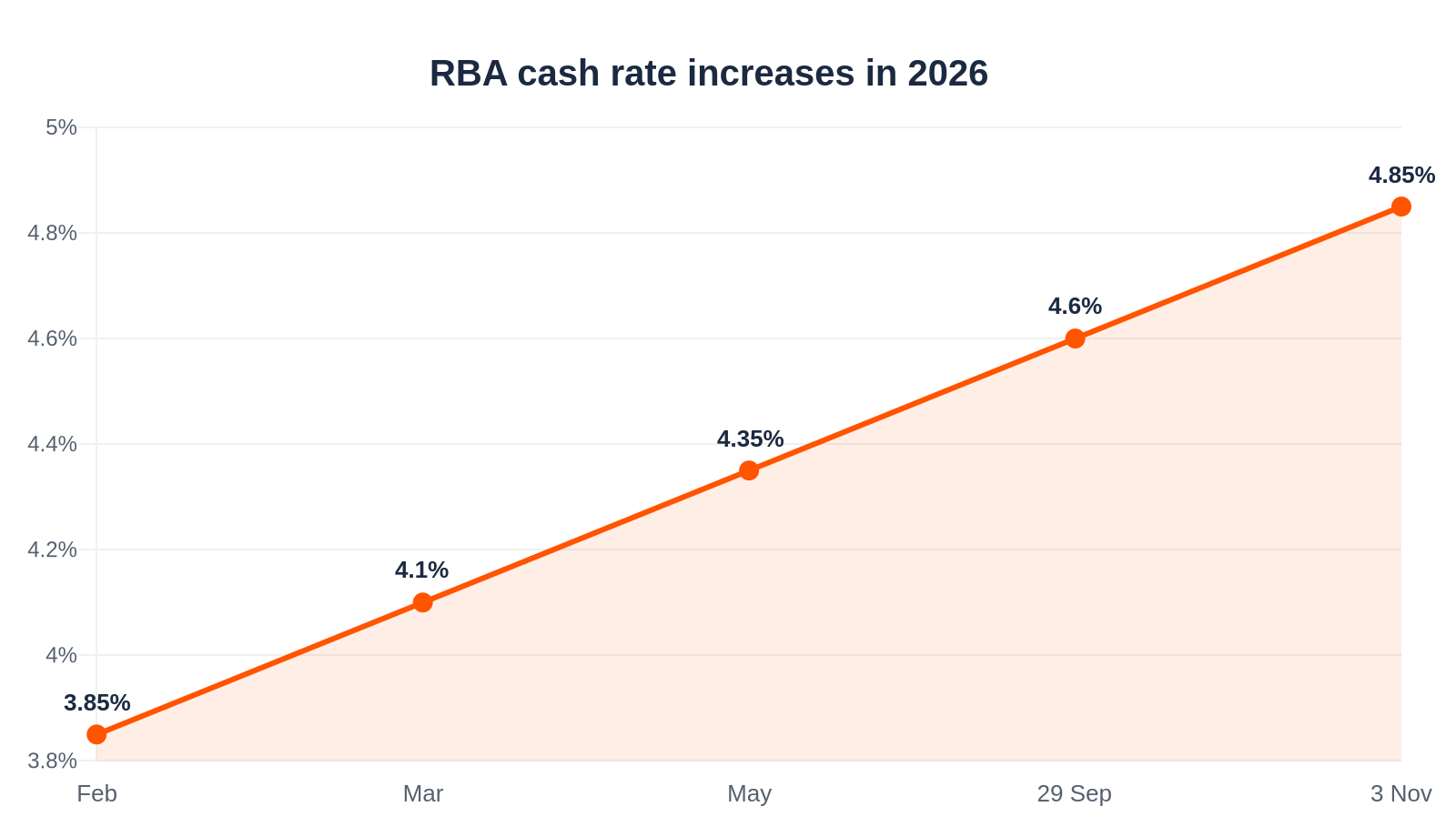
Five rises in 2026 took the cash rate to 4.85%, with a hold at 4.35% in August. Source: RBA cash rate decisions.
February 2026: 3.85%
March 2026: 4.10%
May 2026: 4.35%
29 September 2026: 4.60%
3 November 2026: 4.85%
The RBA held at 4.35% in August (RBA, cash rate decisions and board minutes). The cash rate isn't the rate you pay. According to Moneysmart, lenders set their own home loan rates, which also depend on your credit profile and competition. The RBA says its next decision is due at 2.30pm AEDT on 8 December 2026, which is a sensible date to review your numbers.
How the serviceability buffer works: your rate plus 3 percentage points
The serviceability buffer is the extra margin lenders add when testing whether you can afford a loan. Under APRA's prudential standard APS 220, banks must assess new home loan borrowers at a rate at least 3 percentage points above the loan product rate (APRA).
For example, if a hypothetical loan rate were 6.9%, the lender would test repayments at about 9.9%. That is how assessment rates end up close to 10%. This is a hypothetical, not a lender rate.
The buffer isn't the only limit. APRA states that since 1 February 2026, banks (ADIs) can write no more than 20% of new mortgage lending at a debt-to-income ratio of 6 times or more, measured separately for owner-occupier and investor lending. It applies to banks, not non-bank lenders.
Why each rise cuts how much you can borrow, even when prices fall
A lender works backwards from what you can afford to repay, and the property price doesn't enter that step. A higher test rate means the same budget supports a smaller loan.
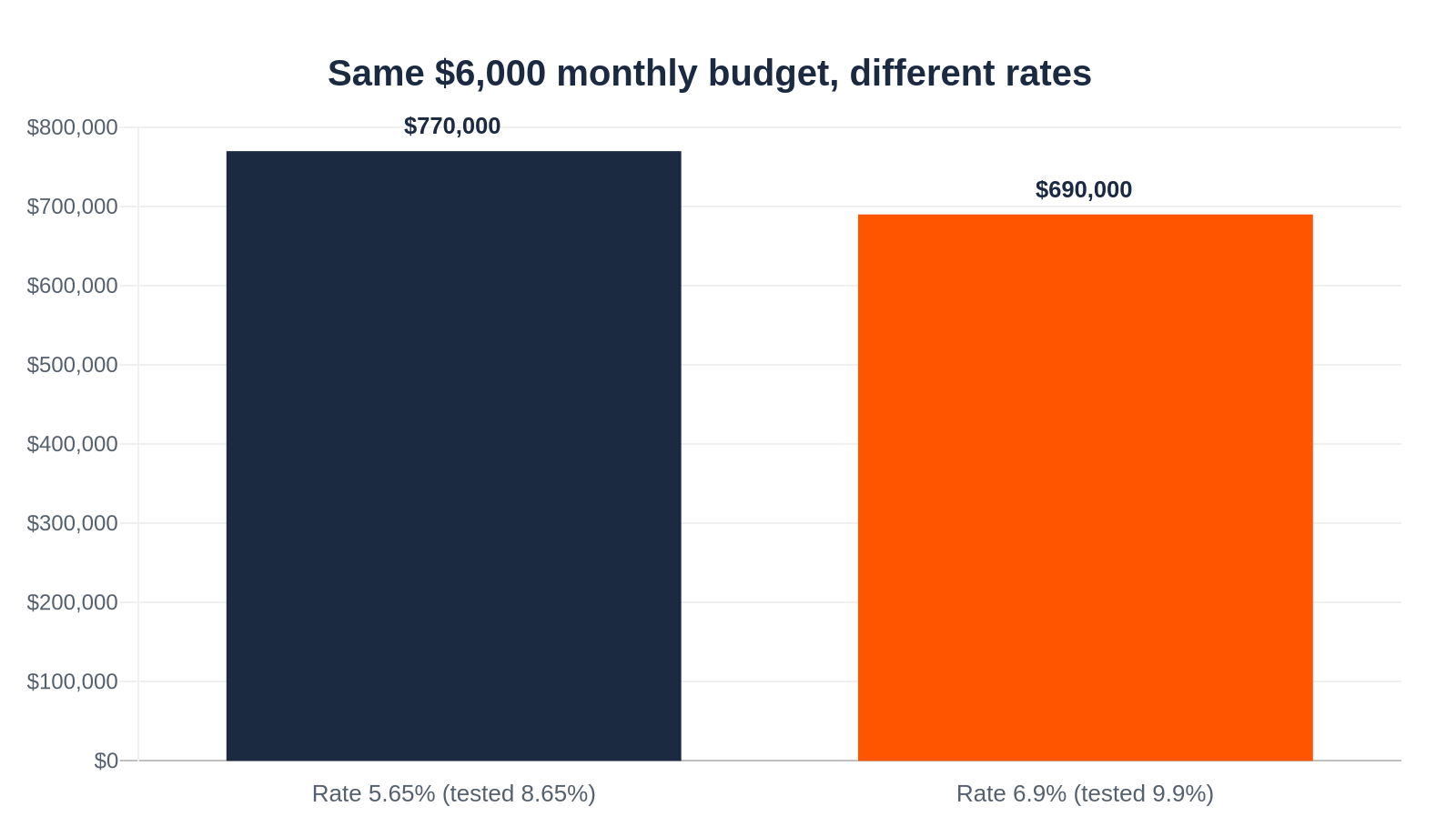
A 1.25-point rise cuts what the same budget supports by about $80,000 (10%). Source: Illustrative example from this article (simplified).
Hypothetical example: Assume a buyer's budget supports assessed repayments of $6,000 a month on a 30-year principal-and-interest (P&I) loan. At a hypothetical 5.65% loan rate, tested at 8.65%, that supports roughly $770,000. After a 1.25-point rise to 6.9%, tested at 9.9%, the same budget supports roughly $690,000. That is about $80,000 (10%) less. Real assessments also weigh income, expenses and debts, so treat this as a simplified illustration.
What a broker may check first. Applications can be affected by inputs as well as the rate, such as living expenses that don't match bank statements, forgotten debts or card limits, or income a lender won't fully count. Checking those first can show where your capacity is being set.
The numbers side by side: borrowing capacity vs the Melbourne median
How much borrowing capacity can fall (hypothetical)
We haven't relied on third-party modelling of national borrowing capacity here, because it isn't from an approved official source. The hypothetical above shows the mechanism. A 1.25-point rise in the loan rate cut assessed capacity by about 10% with the budget unchanged. Your own result depends on your income, debts and expenses. The borrowing power calculator on askfinancials.com.au can give you a starting estimate.
How far Melbourne values have fallen since January
Illustration only. The Melbourne figures are medians for all dwellings, not just houses.
The hypothetical capacity example comes from a simplified calculation, not measured data, so it can't be compared directly with the Cotality median value. It only shows how a higher rate can reduce borrowing capacity even while prices fall.
Why these two figures aren't a like-for-like comparison
The hypothetical buyer is a set of assumptions, while the Melbourne figure is a median across thousands of dwellings. The time periods differ too. The capacity example covers all five rises to November, while the Cotality values run to 30 September. Your own capacity depends on your income, debts and expenses.
What the latest market data says
The ABS Lending Indicators (released 14 August 2026) show new dwelling loan commitments fell 5.4% to 134,225 in the June quarter 2026 (seasonally adjusted, excluding refinancing). First home buyer loans fell 2.9%. That quarter was before the September and November rises. ABS Total Value of Dwellings (released 8 September 2026) shows the mean price of residential dwellings in Australia fell by $8,200 to $1,100,400 in the June quarter 2026.
Why cheaper homes haven't meant cheaper repayments in Melbourne

Lower price, higher rate: the repayment maths
A lower price reduces the loan, but a higher rate raises the cost of every dollar borrowed. The two can nearly cancel out, or even reverse, as the example below shows.
Hypothetical example: the same home in January vs today
The price is down 8%, yet the repayment is up about $73 a month (about 1.4%). Lenders mortgage insurance (LMI) could apply at these loan-to-value ratios (LVRs). LVR is the loan as a percentage of the property's value. According to Moneysmart, LMI protects the lender, not the borrower, and usually applies when you borrow more than 80% of the property value. It isn't included here. The rates are illustrative, not lender offers or advertised rates. Figures are illustrative only and are not a quote or offer. You can test your own numbers in the repayment calculator on askfinancials.com.au.
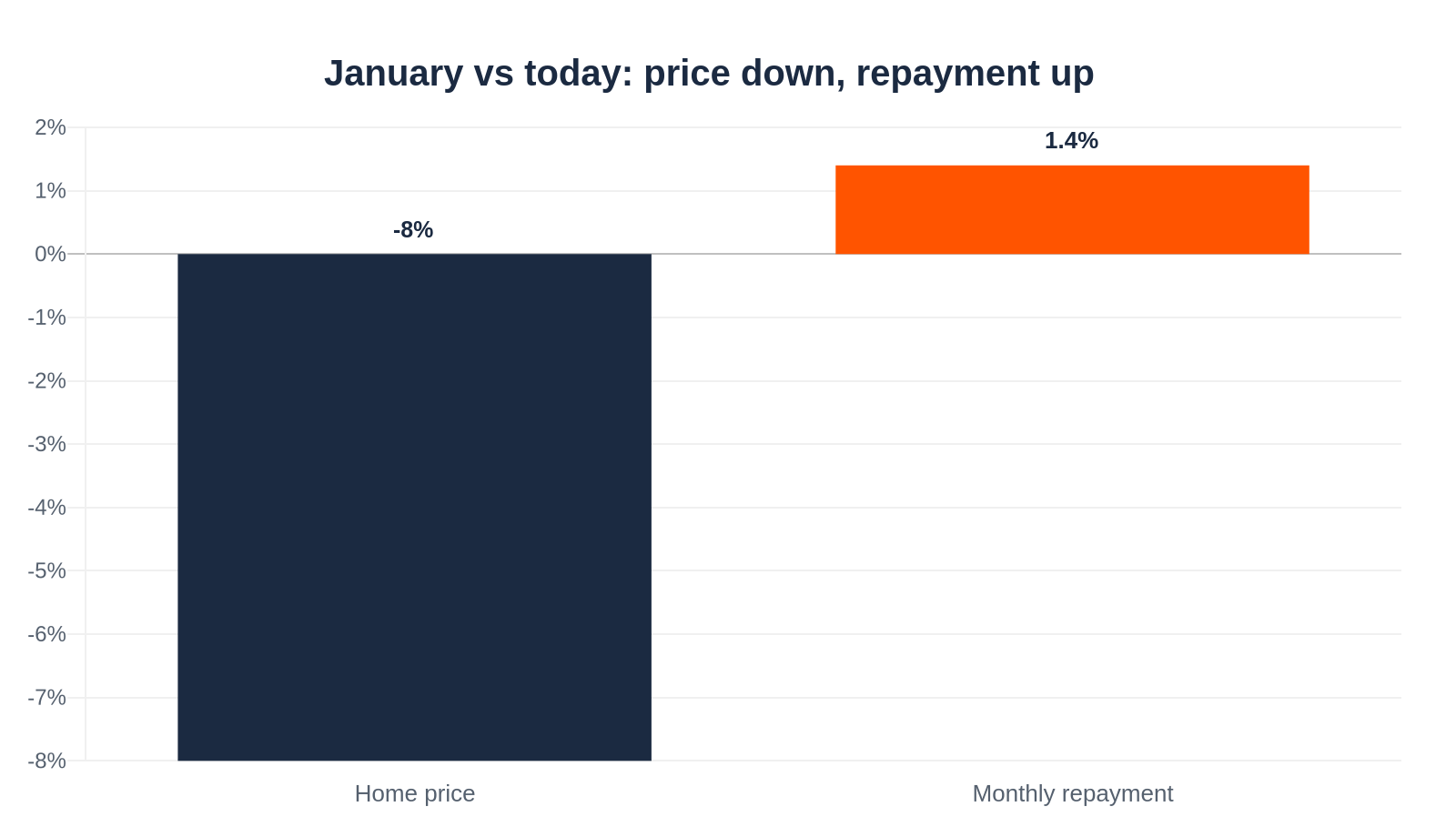
The price is 8% lower, but a higher rate lifts the repayment by about 1.4% (about $73 a month). Source: Illustrative example from this article.
Not sure where you stand? Book a free strategy call with ASK Financials.
Should I wait for the bottom? A simple test
Waiting may help only if your deposit or income grows faster than your borrowing capacity falls
Ask yourself:
Deposit: How much could you realistically add over the next 12 months, after living costs?
Income: Is your household income likely to change, and would a lender count it?
Rent: What will rent cost while you wait? Rent isn't recovered.
Rate risk: How might a further rate move, or a lender policy change, affect your capacity?
No one can reliably time the bottom of the market, so this test is about your numbers, not market calls.
Hypothetical example: 12 months of saving vs a capacity fall
All numbers here are hypothetical. A buyer has a $60,000 deposit and a modelled capacity of $770,000, a combined purchasing budget of about $830,000. Over 12 months they save a further $24,000 after rent and living costs. Their modelled capacity falls $80,000 to $690,000.
Their new budget is $84,000 plus $690,000, or about $774,000. That is about $56,000 (roughly 7%) lower. Waiting would have only paid off if prices in their target range fell by more than that, or their income grew enough to offset the fall.
It can run the other way. If capacity held steady or rose, the same savings could improve the position. That is why this depends on your situation.
The risks you can't control: rates, prices and your own costs
Rates, prices and living costs can all move. The ABS reported CPI up 4.3% in the 12 months to September 2026 (released 28 October 2026), with housing the largest contributor (+5.2%). That is part of the backdrop the RBA weighs against its 2-3% inflation target, and it can also push up your own expenses.
What may move the needle on your borrowing capacity

Capacity is a structure problem, not a timing game. Structure is King, and these levers are the ones you control.
A bigger deposit (and how it affects LVR and LMI)
A bigger deposit means a smaller loan. According to Moneysmart, LMI usually applies above 80% LVR, so a larger deposit may reduce or remove that cost. It doesn't directly raise the maximum a lender will assess you for from income.
Clearing debts and reducing credit card limits
Clearing a debt removes its repayment from your assessment. Lenders may count your credit card limit rather than your balance when assessing your loan, so an unused card with a high limit could affect your borrowing capacity, depending on the lender. Check each lender's policy.
The 5% Deposit Scheme: Victorian price caps and eligibility
According to Treasury, since 1 October 2025 the scheme has had unlimited places and no income caps. The Australian Government's firsthomebuyers.gov.au scheme guide states that eligible buyers need a minimum 5% deposit (2% under the Single Parent stream) and pay no LMI, because Housing Australia guarantees up to 15% of the property value (up to 18% for the Single Parent stream) to a participating lender. Applicants must be Australian citizens or permanent residents aged 18 or over. They must be first home buyers or not have owned property in Australia in the last 10 years (the Single Parent stream doesn't require first home buyer status). The home must be for you to live in, and the loan must be P&I with a participating lender, for up to 30 years. You can't apply to Housing Australia directly. You apply through the lender as part of a home loan application.
Cotality's 30 September 2026 index puts the Melbourne median dwelling value at $780,550, below the $950,000 cap, but individual properties vary. Before you make an offer, check the property's price against the cap for its location on the firsthomebuyers.gov.au scheme page, because caps can be reviewed. The scheme helps with the deposit hurdle, but the loan still has to pass serviceability.
Victorian checks: transfer duty concessions and the First Home Owner Grant
Victoria has transfer duty (stamp duty) concessions and a First Home Owner Grant. Eligibility and amounts change, so confirm current details with the State Revenue Office Victoria. Use the stamp duty calculator on askfinancials.com.au for an estimate.
Pre-approval: why it's worth reviewing every quarter
Is a pre-approval still valid after a rate rise?
A pre-approval is conditional and isn't a guarantee of final approval. At full application the lender may reassess you, including at a higher assessment rate. Validity periods vary by lender, so check your lender's terms.
A simple review checklist
After each RBA decision (next: 8 December 2026), ask whether your capacity has changed.
Update payslips and expenses so the figures reflect your current position.
Recheck debts and card limits for anything new or unused.
Confirm price caps on firsthomebuyers.gov.au if you plan to use the 5% Deposit Scheme.
How a broker can help when borrowing capacity is moving

A broker can compare how different lenders assess serviceability and check whether your structure is set up efficiently. That covers debts, limits, deposit and scheme eligibility. A broker can also recheck your pre-approval as rates change. According to ASIC, brokers must act in the best interests of the consumer when providing credit assistance (s158LA National Credit Act). ASIC also notes that most consumers don't pay brokers directly, because lenders typically pay the broker commission.
If you'd like to check your current borrowing capacity, book a free strategy call.
Key takeaways
Prices have fallen, but borrowing capacity can fall faster when rates rise.
The 3-point APRA buffer means every rise in your loan rate flows straight into the rate you're assessed at.
As the hypothetical shows, a cheaper home can still cost more each month if rates rise enough.
Waiting may only help if your savings or income outpace the capacity fall.
You control your deposit, debts, limits, 5% Deposit Scheme eligibility and quarterly pre-approval checks.
Frequently asked questions
Should I wait for house prices to bottom out before I buy?
Waiting may only help if your income or deposit grows faster than your borrowing capacity falls, depending on your situation. No one can reliably time the bottom of the market. Compare your own deposit growth, rent costs and the effect of a possible further rate move before deciding. Rent isn't recovered, so the cost of waiting matters as much as any price view.
If house prices fall, can I afford more?
Not necessarily. According to APRA, banks must assess new borrowers at their loan rate plus at least 3 percentage points. When rates rise, the amount a lender will lend may fall, sometimes faster than prices. Your income, debts and expenses also matter, depending on your situation. A lower price helps only if your assessed capacity holds up.
What is the serviceability buffer on a home loan?
It's the margin lenders add to test whether you could still afford repayments if rates rose. Under APRA's APS 220, banks must assess new borrowers at least 3 percentage points above the loan product rate. A hypothetical 6.9% loan would be tested at about 9.9%. That is an example only, not a lender rate, and your own assessment will vary.
How do RBA rate rises affect how much I can borrow?
Lenders set their own rates, but the cash rate influences them. When a lender's rate rises, its assessment rate rises too, so the same income may support a smaller loan. According to the RBA, the cash rate is 4.85% (effective 4 November 2026), and the next decision is on 8 December 2026.
Is a mortgage pre-approval still valid after a rate rise?
A pre-approval is conditional and isn't a guarantee. At full application, a lender may reassess you, including at a higher assessment rate. Validity periods vary by lender, so check your terms and review your pre-approval after each RBA decision. Treat it as a starting point rather than a promise of final approval.
Do credit card limits reduce my borrowing capacity?
They may. Lenders may assess the card limit, not your balance, so an unused card with a high limit could still count against your assessment. Treatment varies, so check each lender's policy. Reviewing your limits, depending on your situation, is one way to check your structure before applying.
If you'd like help checking your numbers, book a free strategy call with ASK Financials.
About the author
Amol is a Melbourne mortgage broker and former ANZ director, qualified in mortgage broking, accounting and financial planning. He was named Metro Broker of the Year 2026 at the BIA Awards.
Checked against official Australian sources, including the Reserve Bank of Australia.
Last updated: 15 November 2026
General information only. This article does not take into account your objectives, financial situation or needs. Consider whether the information is appropriate for you and seek personalised advice before acting. Tax information is general in nature; speak to a registered tax agent about your circumstances. Lending criteria, fees and charges apply. ASK Financials (ABN 48 661 070 962) is Credit Representative 543187 authorised under Australian Credit Licence 389087.
